Online Quran Classes with Tajweed for Kids in USA | Free Trial — Quran Skool
بِسْمِ ٱللَّٰهِ ٱلرَّحْمَٰنِ ٱلرَّحِيمِ
Online Quran Classes • USA • Established Tradition

Online Quran Classes with Tajweed for Kids in the USA

A child-first, scholar-led path to the Book of Allah ﷻ — taught the way our beloved Prophet Muhammad ﷺ taught: with patience, gentleness, and love for the learner.

وَرَتِّلِ ٱلْقُرْءَانَ تَرْتِيلًا

"And recite the Qur'an with measured recitation."

— Surah Al-Muzzammil 73:4
Ijazah-Certified Tutors All US Time Zones Male & Female Teachers 1-on-1 Live Sessions
In The Name Of Allah

A Word For The Muslim Parent in America

Assalamu Alaikum wa Rahmatullahi wa Barakatuh.

Alhamdulillahi Rabbil 'Alameen, all praise is due to Allah ﷻ — the One Who revealed the Qur'an as "a guidance for mankind" (هُدًى لِّلنَّاسِ — Surah Al-Baqarah 2:185). And may the choicest of salutations be upon our beloved Messenger Muhammad ﷺ, his noble family, and his blessed Companions, and upon every soul who carries the Qur'an in their heart until the Day of Resurrection.

Dear parent — your child is eight years old. Perhaps ten. Smart, curious, fully alive to the world around them: YouTube, school projects, soccer practice, the rhythm of American childhood. They will sit for an hour with something they love and never look at the clock.

But the moment Qur'an class begins? Something quiet shifts. Not rebellion. Not refusal. Just a slow distance that turns into "later," and "not now," and "do I really have to today?"

If you are raising Muslim children in Houston, New Jersey, Chicago, the DFW metroplex, or any corner of this vast land — you know this feeling. According to a 2023 study by the Institute for Social Policy and Understanding, more than 60% of Muslim parents in America report serious difficulty maintaining consistency in their children's Islamic education. This is not a parenting failure. It is a systems failure.

Hadith of the Prophet ﷺ خَيْرُكُمْ مَنْ تَعَلَّمَ الْقُرْآنَ وَعَلَّمَهُ

"The best among you are those who learn the Qur'an and teach it."

— Sahih al-Bukhari 5027 · Narrated by Uthman ibn 'Affan (R)

The Prophet ﷺ did not say, "the best are those who finish the Qur'an quickly." He linked excellence to learning and teaching — a relationship, not a transaction. Our children are not resisting the Qur'an. They are resisting an environment that has not been designed for them. And by the tawfiq of Allah ﷻ, that environment can be rebuilt.

This is the work of Quran Skool. Bi'idhnillah — by His permission — we present, in the pages that follow, a method rooted in the Sunnah of the Messenger ﷺ and shaped for the Muslim child of the West.

Begin Today, In Sha Allah

Book a Free Trial — No Cost, No Commitment

Witness the child-first method with your own eyes. One full session, with a qualified Hafiz or female Mu'allimah of your choice.

Chapter One

The Real Reason Kids in America Disconnect from Qur'an Learning

Before we speak of solutions, we must speak honestly about the cause. The disconnect is not spiritual — it is pedagogical. And it is fixable, in sha Allah.

The American child — whether in public school, charter school, or homeschool — is shaped daily by an educational environment carefully engineered for engagement. Teachers use visual aids. Lessons are broken into focused segments. Apps reward small wins. Praise is structured, immediate, and warm.

Then the child logs into an online Qur'an class. And what awaits?

  • A teacher who may not speak their child's primary language fluently;
  • A method built on sit-and-repeat, with little interaction;
  • Correction that arrives before connection;
  • No visual reinforcement, no engagement layer, no rhythm of reward;
  • A format unchanged for decades — for a child who has never known a world without screens.

This is not a critique of Islamic values. It is a recognition that tarbiyah (nurturing) and ta'lim (instruction) must meet the child where Allah ﷻ has placed them.

From the Scholarly Tradition

Imam Ibn Khaldun (rahimahullah) wrote in his Muqaddimah that harshness in early instruction "spoils the soul of the learner and dulls the desire for knowledge." He counseled gentleness as the foundation of education — a principle echoing the very Sunnah of our Messenger ﷺ.

The Sunnah of Gentleness إِنَّ الرِّفْقَ لَا يَكُونُ فِي شَيْءٍ إِلَّا زَانَهُ

"Verily, gentleness is not found in anything except that it beautifies it, and it is not removed from anything except that it disfigures it."

— Sahih Muslim 2594 · Narrated by Aishah (R)

Our children are not less religious than the generations before. They are simply learning differently. When the teaching style does not speak the language of their minds, they withdraw — not from the Book of Allah, but from the chair that has been placed before it.

Chapter Two

Why Traditional Online Qur'an Classes Are Not Built for American Kids

When online Qur'an classes first arrived in American homes, they were a mercy and a leap forward, Alhamdulillah. Parents could connect their children to qualified Quran tutors from Pakistan, Egypt, and the lands of the Haramayn — without ever leaving the house.

Yet most providers missed something quiet but decisive: moving the classroom online does not automatically make it work for the American child.

The same methodology continued, simply on a screen:

  • Rote repetition as the primary teaching tool;
  • Heavy emphasis on correction before comprehension;
  • Group sessions where the fastest learner sets the pace;
  • Tutors trained in classical Islamic education — but not in child development or Western pedagogy;
  • No structured bridge for bilingual children who think in English yet are taught in Arabic.

For Pakistani, Bangladeshi, and Indian Muslim families settled in the USA, UK, and Canada — particularly in the second generation — there is an additional dimension. These children navigate two worlds: American at school, Muslim at home. If their Qur'an education feels like it belongs to a "different world," they will keep the worlds separate — and the Book of Allah ﷻ becomes something they visit, not something they live.

The result is heartbreaking in its quietness: a child who attends 45 minutes of class, retains nothing, completes the Qaida without reading independently, and "finishes" the Qur'an without tasting its sweetness. That is not learning — that is attendance.

A Reflection From Imam Al-Ghazali

In Ihya Ulum al-Din, Imam al-Ghazali (rahimahullah) writes that the teacher's foremost duty is "to be merciful toward the student and to treat him as one's own child." This is not sentimentality — it is methodology. Mercy is the soil in which knowledge takes root.

Chapter Three

What is Tajweed — And Why It Matters More Than Most Realise

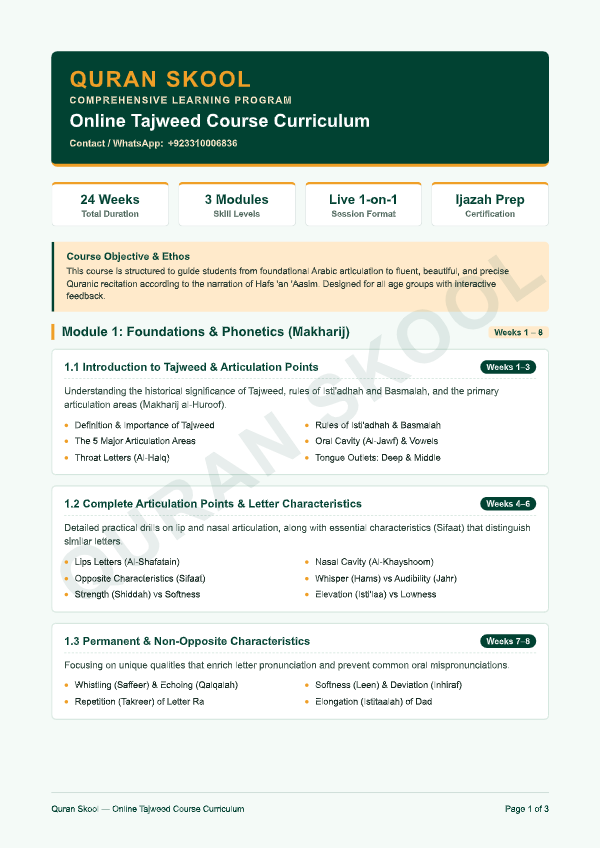
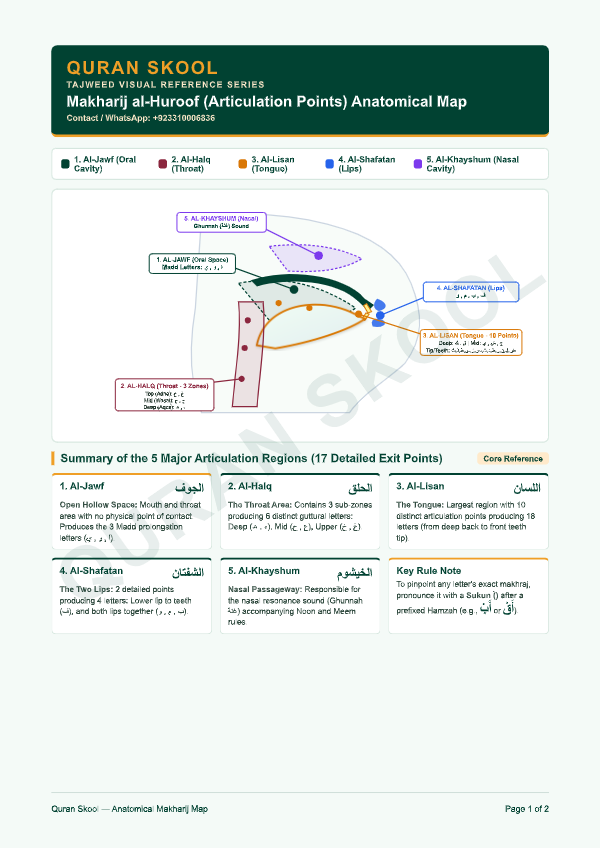
The word Tajweed (تَجْوِيد) comes from the root j-w-d, meaning "to make excellent" or "to beautify." In the science of Qur'anic recitation, it refers to the rules governing the precise articulation of every Arabic letter — the exact point of emission in the mouth or throat (Makharij), the proper duration of vowels, the nasal qualities (Ghunnah), and the rules of pause and continuation (Waqf and Wasl).

In simple terms: Tajweed is the difference between reciting the Qur'an as it was revealed by Jibreel (AS) to the Messenger ﷺ, and reciting it in a way that may even alter its meaning.

The Command of Recitation ٱلَّذِينَ ءَاتَيْنَـٰهُمُ ٱلْكِتَـٰبَ يَتْلُونَهُۥ حَقَّ تِلَاوَتِهِۦٓ

"Those to whom We have given the Book recite it as it should be recited — they are the ones who believe in it."

— Surah Al-Baqarah 2:121

The classical scholars — Ibn al-Jazari (rahimahullah) foremost among them — declared in his celebrated didactic poem Al-Muqaddimah al-Jazariyyah:

وَالأَخْذُ بِالتَّجْوِيدِ حَتْمٌ لَازِمُ ۞ مَنْ لَمْ يُجَوِّدِ الْقُرْآنَ آثِمُ

"Holding to Tajweed is an absolute obligation; whoever does not recite the Qur'an with Tajweed is sinful."

— Imam Ibn al-Jazari, Al-Muqaddimah

Why this matters for your family in America:

  • Many common mispronunciations actually alter the meaning of the Arabic word. The letter ḍād (ض) is not the letter dāl (د). The 'ayn (ع) is not the hamzah (ء). These are not stylistic preferences — they are the very fabric of Qur'anic meaning.
  • Habits of incorrect pronunciation formed early are extraordinarily difficult to correct later, as every classical teacher will testify.
  • The Messenger ﷺ recited with Tajweed and instructed his Companions to do likewise — making it a Sunnah practice with deep shar'i weight.
  • A child who learns Tajweed early carries that excellence into adulthood — into the prayers they lead, the children they will one day teach, and the global Ummah they will one day represent.

At Quran Skool, Tajweed is not a separate "advanced" topic locked behind years of study. It is woven into every stage of the curriculum from the very first lesson — introduced through sound-awareness and phonics in the early years, then deepened into formal rules as fluency matures.

Chapter Four

The Quran Skool Methodology — A Child-First Path

When we designed Quran Skool, the founding question was not "How do we teach Tajweed online?" — but rather, "What if learning the Qur'an felt as natural to a child as everything else they already love?"

The Prophetic Method يَسِّرُوا وَلَا تُعَسِّرُوا وَبَشِّرُوا وَلَا تُنَفِّرُوا

"Make things easy and do not make them difficult; give glad tidings and do not repel."

— Sahih al-Bukhari 69 · Narrated by Anas ibn Malik (R)

The "Play & Pray" Philosophy

Not a technique applied on top of traditional teaching — but the very environment in which all teaching occurs.

Engagement Before Correction

Children are encouraged to attempt, explore, and produce before they are guided toward accuracy. The first principle of the Sunnah is to draw the heart near.

Appreciation Before Discipline

Positive reinforcement — never pressure or scolding — drives the child forward. The Prophet ﷺ never struck a child, never raised his voice in instruction.

Connection Before Perfection

A child who enjoys their class will stay long enough to become proficient. A child who dreads it will find every reason to escape. We build the relationship first.

Knowledge Through Days & Nights

The great muhaddith Imam Az-Zuhri (rahimahullah) said: "Whoever takes knowledge in one large gulp will lose it in one large gulp." This is the rhythm of our shorter, focused, child-attuned sessions.

A Glimpse Into a Real Session for a 6-Year-Old

  1. 1 The Mu'allim opens with a warm Salaam in English (and Urdu if the family prefers);
  2. 2 The day's letter is introduced with a visual anchor — a shape, a story, a familiar image;
  3. 3 The child attempts the sound in a low-stakes, playful context — without immediate correction;
  4. 4 The teacher mirrors the sound back correctly, modelling Makharij gently and naturally;
  5. 5 Together, they practice through call-and-response, rhythm, and repetition that feels musical, not mechanical;
  6. 6 The session ends with a small visible achievement — a letter mastered, a word read — so the child departs the class feeling capable.

This is the Qur'an meeting the child where Allah ﷻ has placed them — without sacrificing one drop of academic rigour. Wallahul-Musta'an.

Chapter Five

The Three-Level Curriculum — A Path From Letter to Hifz

Every child progresses through three carefully structured levels — paced individually, never rushed, never abandoned.

١
Level One • Beginner • Ages 2.5–8

Quranic Letters & Arabic Phonics

The foundational stage where the seed of Arabic literacy is planted with care.

  • All 28 Arabic letters — recognition, shape, sound
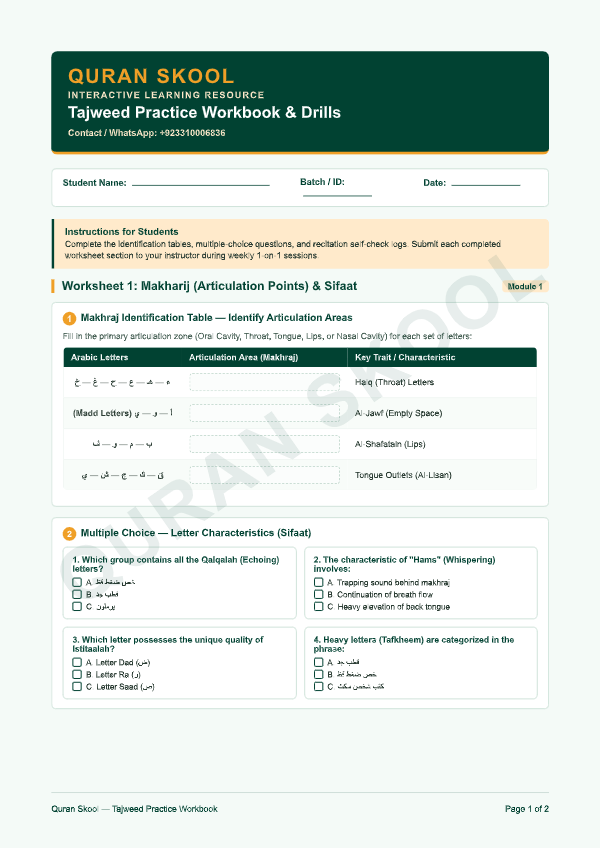
  • Makharij — articulation of every letter
  • Vowel marks: Fathah, Kasrah, Dhammah
  • Letter joining and word formation
  • Noorani Qaida or Iqra Qaida (parent's choice)
  • Visual mnemonics, sensory play, storytime
٢
Level Two • Intermediate

Qur'an Reading with Tajweed

The formal Quranic journey begins — recitation directly from the Mushaf with progressive Tajweed.

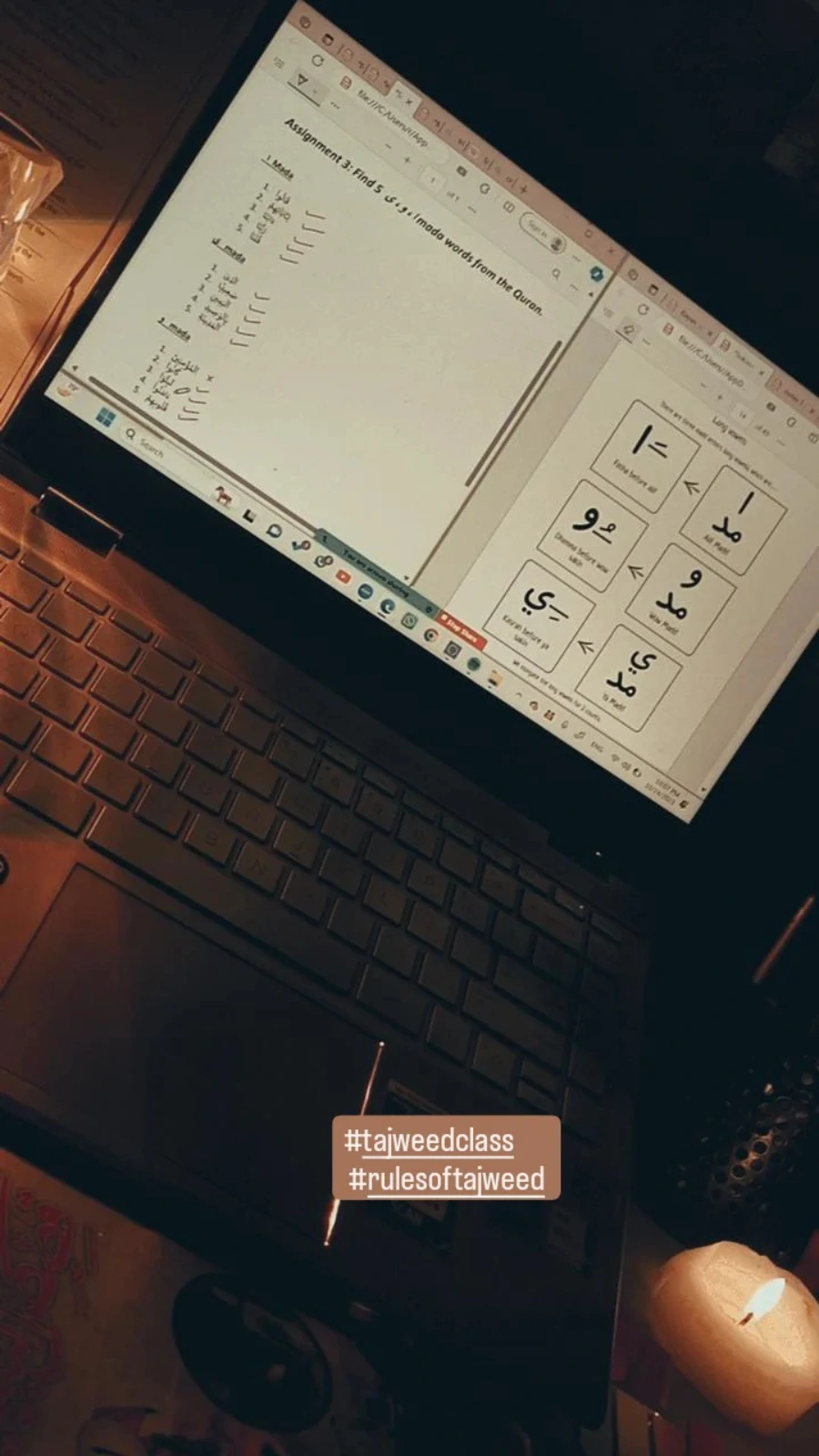
  • Madd (elongation) rules
  • Noon Saakin & Tanween — Idgham, Ikhfa, Iqlab, Izhar
  • Meem Saakin rules in full
  • Tafkhim & Tarqeeq (heavy/light letters)
  • Waqf and Ibtida (pause and start)
  • Surah Al-Fatiha & short surahs with mastery
٣
Level Three • Advanced

Hifz, Salah & Islamic Understanding

Where Qur'an learning becomes Deen — the child begins to own their Islamic identity.

  • Memorisation of Juz Amma (the 30th part)
  • Progression to longer surahs at child's pace
  • Meaning of frequently recited surahs
  • The five daily prayers (Salah) — full procedure
  • The Six Kalimahs
  • Selected Seerah & Sahaba stories
  • Adab, manners, and Islamic identity
Level Focus & Key Milestones
Level 1 — Beginner Arabic letters, Makharij, Noorani Qaida, pre-reading confidence
Level 2 — Intermediate Tajweed rules, Quran reading fluency, surah recitation
Level 3 — Advanced Surah memorisation, Salah, Islamic studies, Quranic meaning
Chapter Six

Who These Classes Are Designed For

Quran Skool serves a wide range of children and families, but we have been especially intentional about serving communities that traditional online platforms often underserve.

By Age and Level

  • Toddlers and Preschoolers (2.5–5): Play-based phonics and gentle letter introduction
  • Early Primary (5–8): Foundational reading through Noorani / Iqra Qaida
  • Middle Primary (8–12): Full Tajweed curriculum with structured progression
  • Older Beginners (12+): Adapted method for teenagers starting from zero — without judgement, without rush
  • Intermediate Students: Children who can read but require Tajweed correction and consistency

By Family Background

  • Pakistani, Indian, and Bangladeshi families in the USA, UK, and Canada seeking culturally familiar tutors
  • Second-generation Muslim households where the child is fluent in English but not Arabic or Urdu
  • Revert (convert) Muslim parents seeking a gentle, welcoming start for their children — "We welcome you, and we welcome your children, MashaAllah"
  • Families who have tried other classes that did not stick — and are giving structured Qur'an education one more sincere attempt, in sha Allah

If your child fits any of these descriptions, MashaAllah, you belong here. Marhaba bikum.

Chapter Seven

Our Mu'allimeen — Certified, Trained, and Devoted to the Child

The most important element of any online Quran class is not the platform, the schedule, or even the curriculum. It is the teacher.

The Status of the Quran Teacher إِنَّ اللَّهَ وَمَلَائِكَتَهُ وَأَهْلَ السَّمَاوَاتِ وَالْأَرَضِينَ ... لَيُصَلُّونَ عَلَى مُعَلِّمِ النَّاسِ الْخَيْرَ

"Verily, Allah, His angels, and the dwellers of the heavens and the earth send blessings upon the teacher of good to the people."

— Sunan At-Tirmidhi 2685 · Hasan

Academic & Religious Qualifications

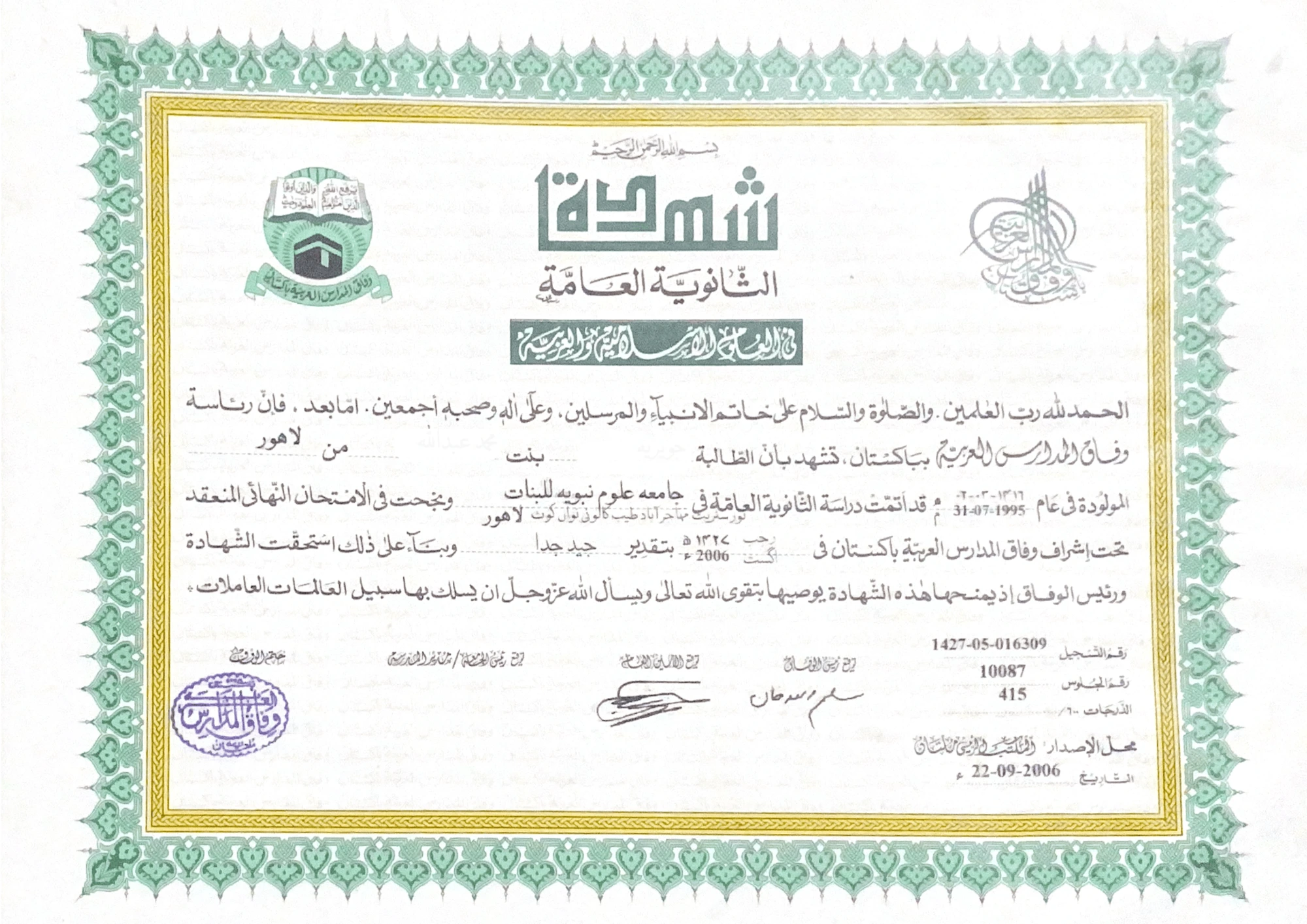
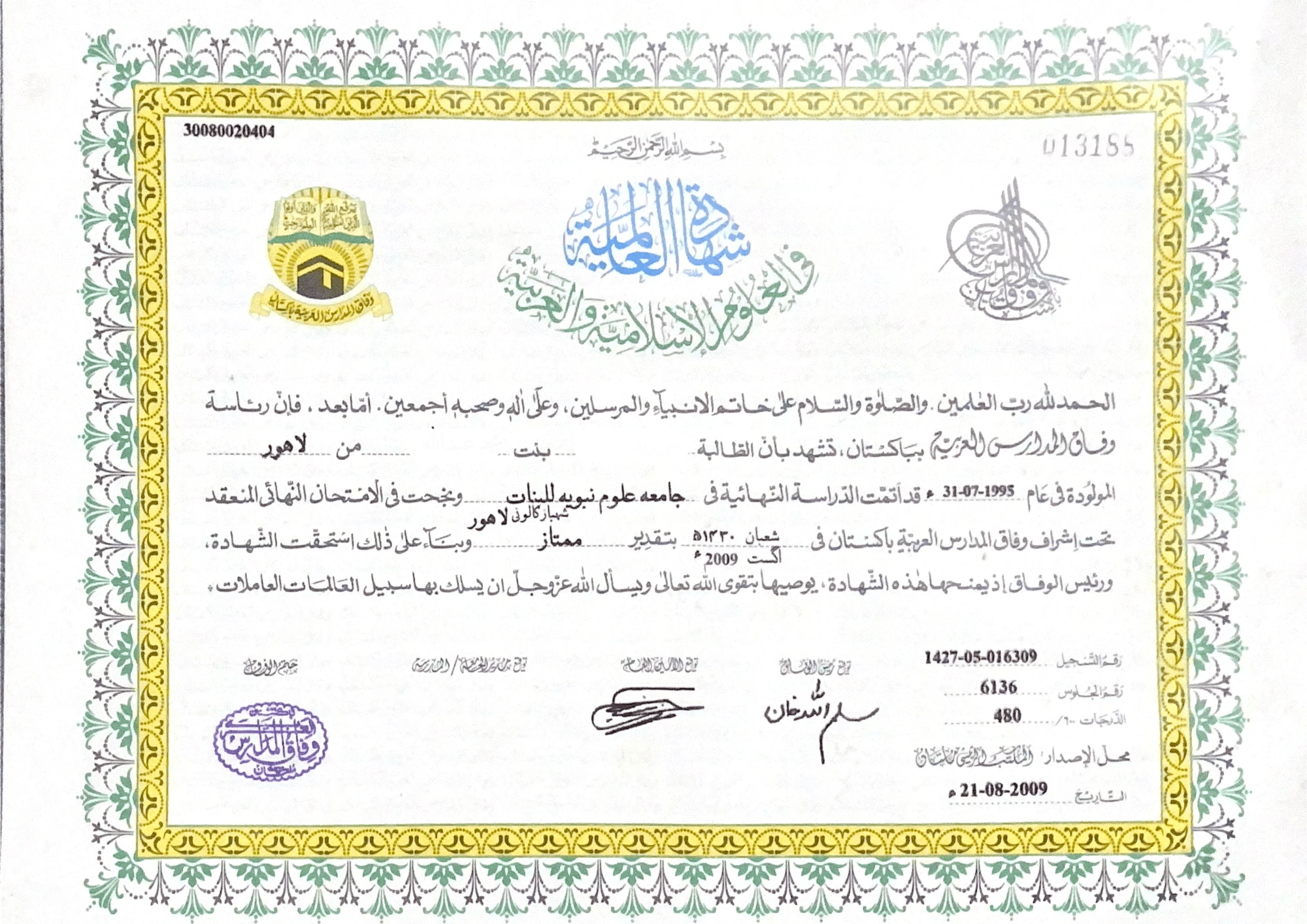
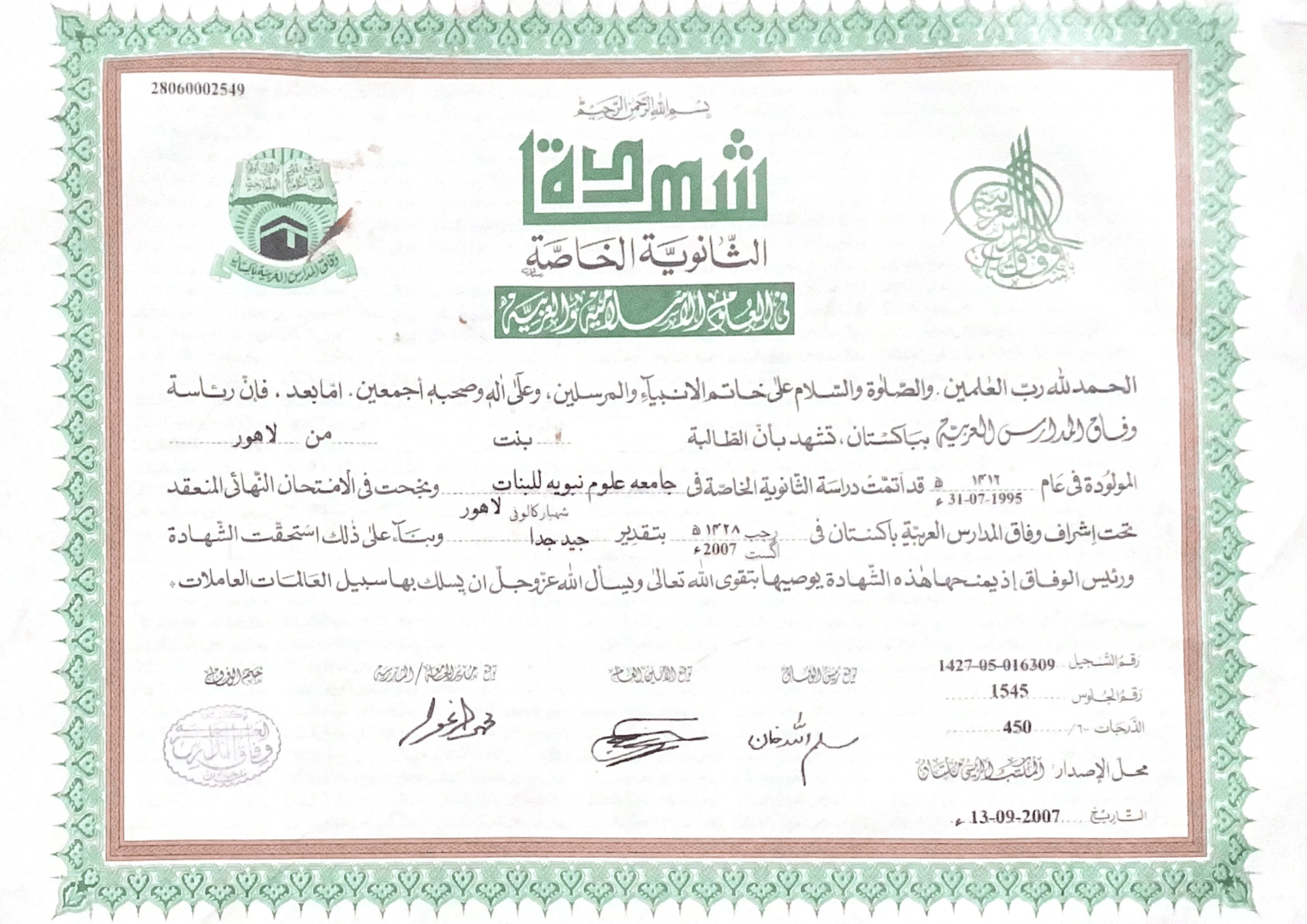
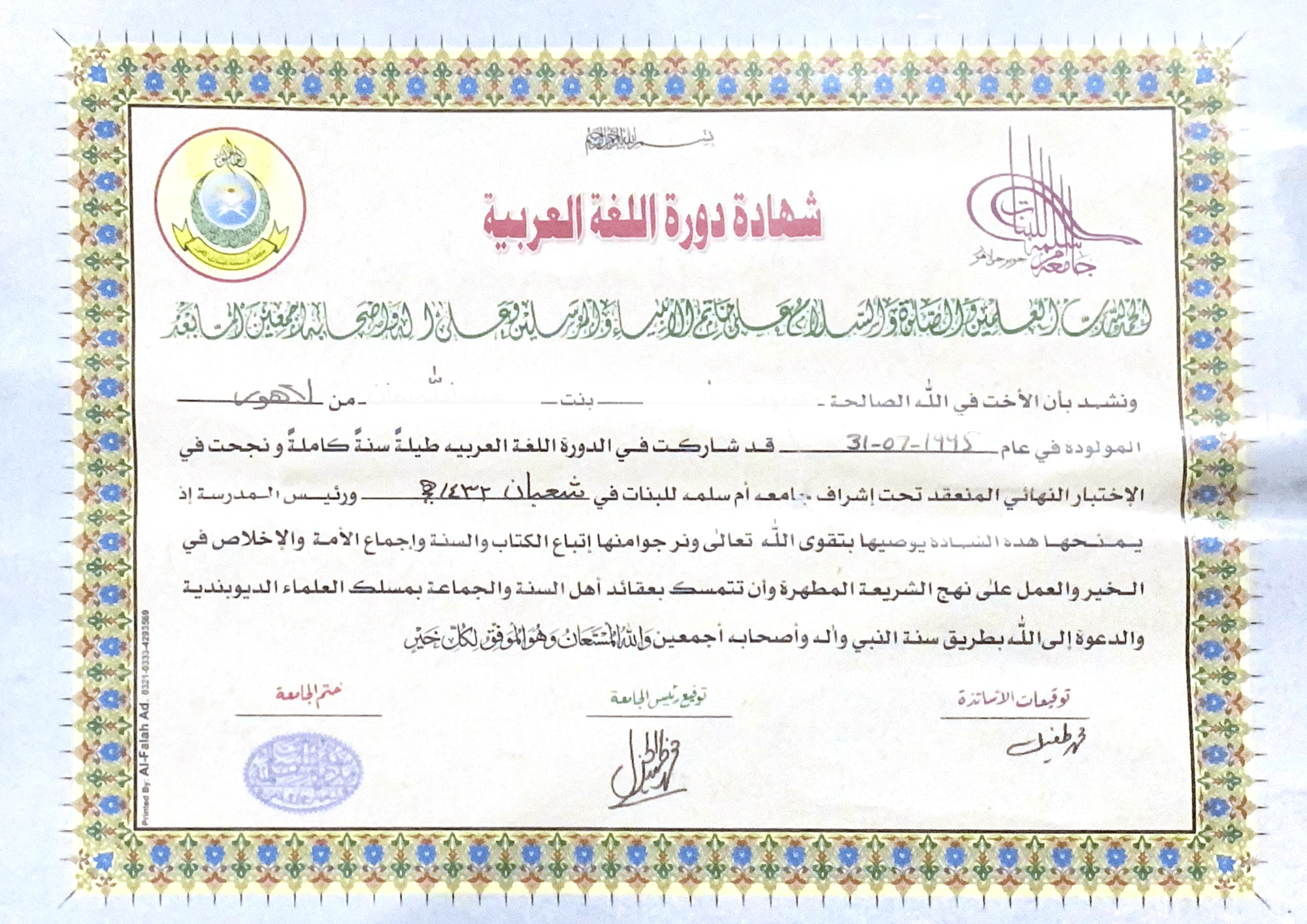
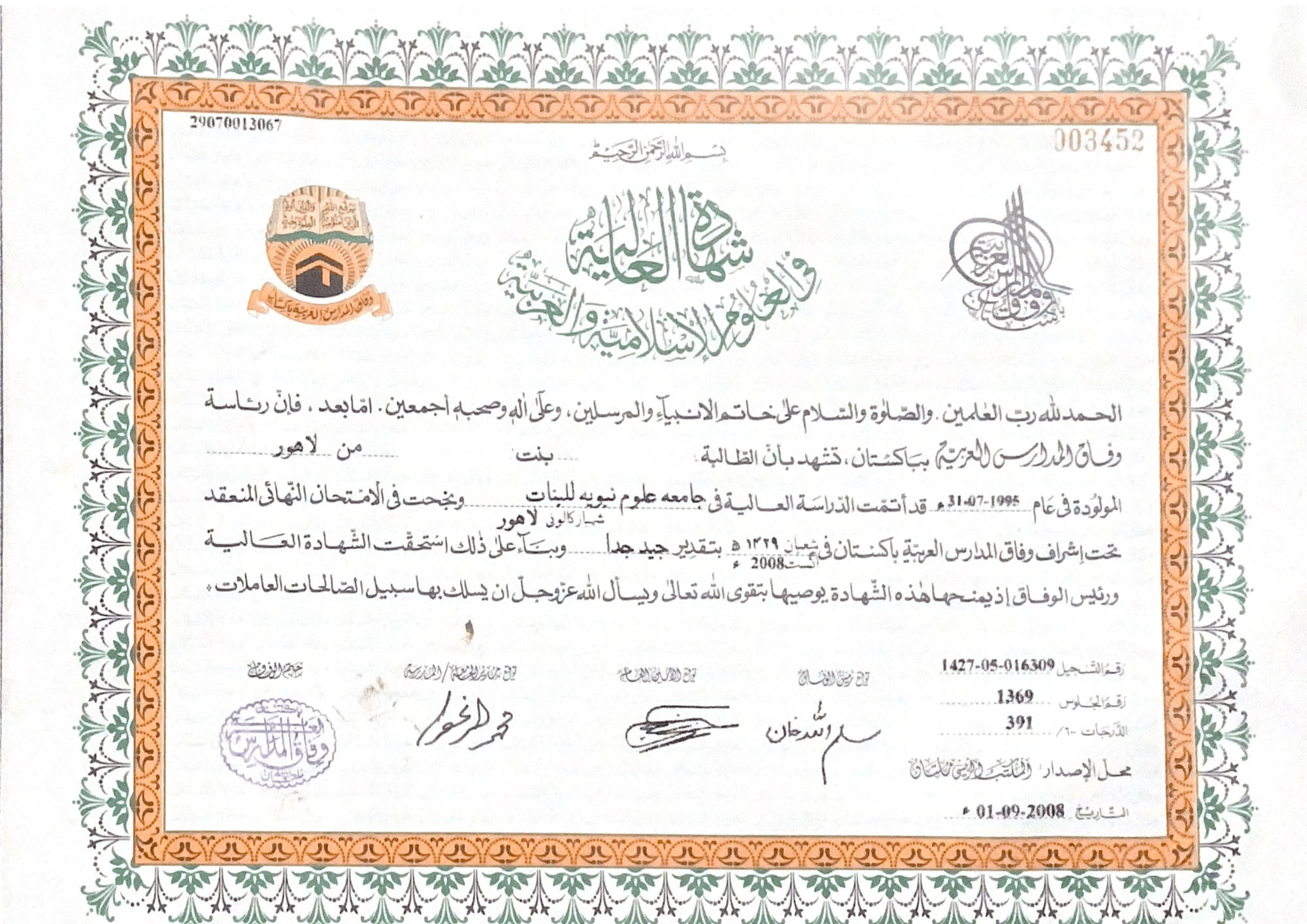
Wifaq-ul-Madaris Certified

The highest tier of Islamic credentialing in the Pakistani madrasa system.

Sabe-e-Ashra Qualified

Mastery of the ten authentic Qira'at of the Qur'an.

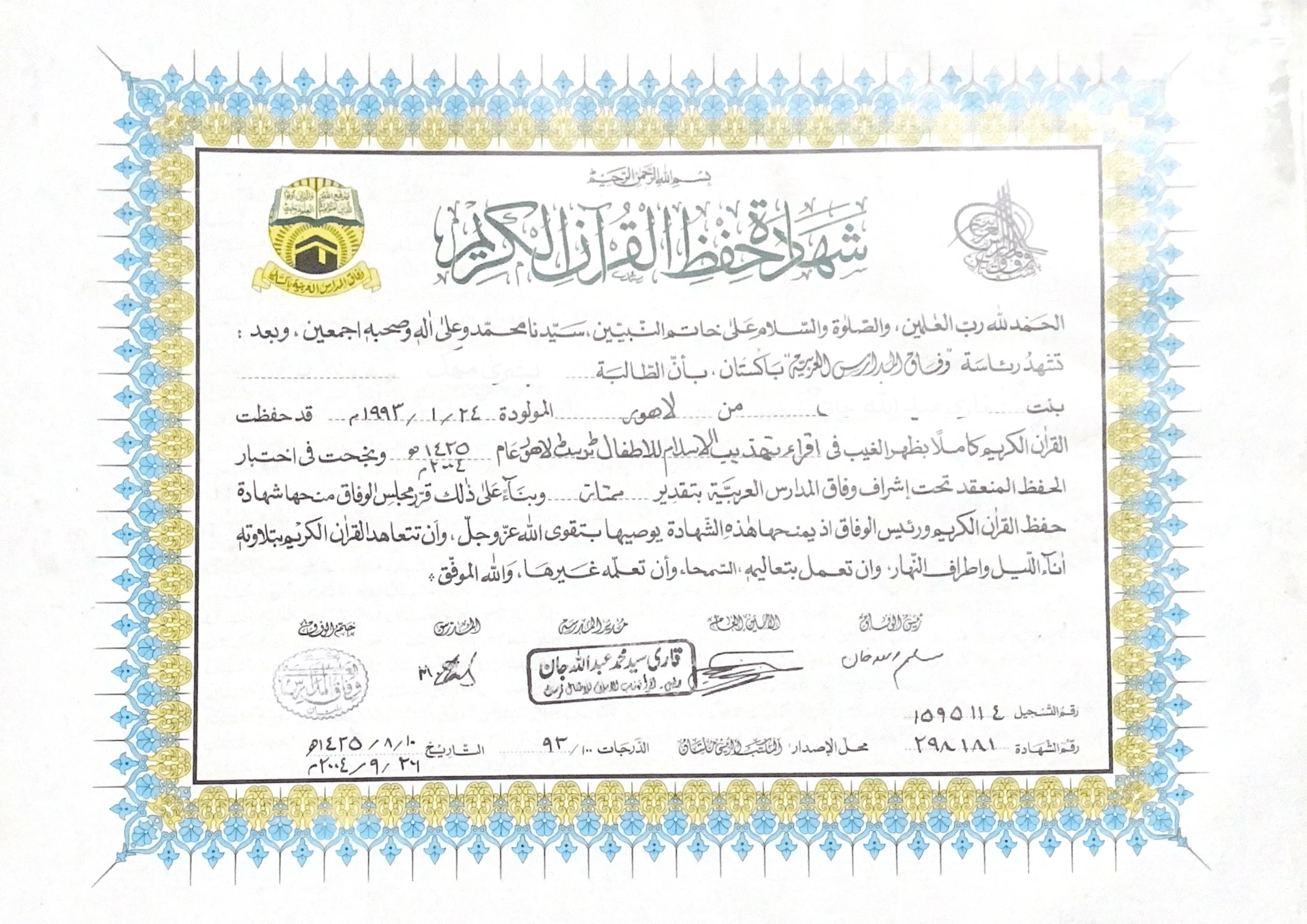
Ijazah-Certified

Holding an unbroken chain of transmission (sanad) of the Qur'an back to the Messenger of Allah ﷺ.

Hafiz al-Qur'an

Having memorised the entire Book of Allah ﷻ.

Pedagogical Training — What Sets Them Apart

  • Trained in child-first methodology across developmental stages 3–16
  • Bilingual instruction — fluent in English, Urdu, and Arabic where required
  • Skilled in maintaining engagement on Zoom and Google Meet
  • Trained specifically for children growing up between two cultures

Male and Female Tutors Available

We offer both male and female Quran tutors for kids, MashaAllah. Many parents — particularly for daughters and younger children — prefer a female Mu'allimah for a gentler, more familiar dynamic. Others prefer a male Mu'allim for older boys. The choice is yours.

Beyond every certificate, every Mu'allim and Mu'allimah at Quran Skool is selected for one quality that no diploma can confer: patience. Not the patience of one who tolerates difficulty — but the active, joyful patience of one who delights in working with children. The patience of Sabr Jameel.

Chapter Eight

Why 1-on-1 Beats Group Classes — Almost Every Time

Group classes are common. They are cost-efficient for the provider. For adults learning socially, they may even succeed. For children? They almost always fail — quietly and gradually.

What actually unfolds in a group Quran class of five to eight children:

  • The fastest learner sets the pace — everyone else falls behind or grows bored;
  • The shy child never asks for clarification — they nod, fall further behind, and slowly disengage;
  • The teacher's attention is consumed by group management, not teaching;
  • A child who mispronounces in front of peers feels embarrassed — and stops volunteering;
  • Progress becomes invisible, averaged out across the group.
The Personal Care of the Prophet ﷺ

The Messenger of Allah ﷺ used to teach his Companions individually according to their capacities. To one he taught a single ayah and asked him to live by it. To another he taught Surah Al-Fatihah and called it the greatest chapter. He met each soul where it stood — and that is the model we strive to follow.

— Drawn from Sahih al-Bukhari & Sahih Muslim

At Quran Skool, every session is 1-on-1. No exceptions.

  • Your child receives 100% of the Mu'allim's attention for the full session;
  • Corrections occur privately, gently, without social pressure;
  • Pace is set entirely by your child — not by a group average;
  • The teacher builds a real personal relationship over time;
  • Progress is tracked individually and reported to parents monthly.

One-on-one Qur'an tuition is not a premium upgrade at Quran Skool. It is the only way we teach.

Chapter Nine

How Classes Work at Home — Practically Speaking

The greatest practical barrier for Muslim families in America is not motivation — it is logistics. Quran Skool was built around the rhythm of your American household, MashaAllah.

What You Need To Begin

  • Any internet-connected device — laptop, tablet, or phone
  • A free Zoom or Google Meet account
  • A quiet space for 25–30 minutes
  • That is all. Bismillah, you are ready to begin.

Scheduling Across U.S. Time Zones

We serve families in all U.S. time zones — Eastern, Central, Mountain, and Pacific — Alhamdulillah. Tutors are available for early morning, after-school, evening, and weekend slots. You choose what suits your child's energy.

No Academic Year. No Waiting Lists.

Your child can begin any day Allah ﷻ permits — there is no September-only enrolment, no cohort schedule, no waiting list. When you are ready, we begin.

Age Group Recommended Session Length
Ages 2.5–5 (Toddler / Pre-K)15–20 minutes
Ages 5–8 (Early Primary)20–25 minutes
Ages 8–12 (Primary)25–30 minutes
Ages 12+ (Teen / Adult)30–45 minutes

Sessions are intentionally short for the young — for fifteen focused, engaged minutes produce more nafa' (benefit) than forty-five distracted ones. As fluency grows, length grows naturally with it, in sha Allah.

Chapter Ten

A Real Family's Journey

From Inconsistency to a Daily Qur'an Habit — Alhamdulillah

What changed wasn't just the teacher. It was that they actually cared whether the kids were engaged. Every session ended with something positive. Our children — Zainab and Ibrahim — started asking to open the Qur'an on their own. That last part is what we had been praying for, MashaAllah.

Tariq and Aisha had tried two other online Quran platforms before finding Quran Skool. The first was a group class run from Pakistan whose timings collided with the children's school day. The second was a 1-on-1 service, but the teacher communicated almost entirely in Urdu — which neither child spoke fluently — and relied on drill-style repetition that left their daughter Zainab visibly disheartened.

"She'd sit in the class and just go blank," Aisha recalls. "She wasn't learning. She was just waiting for it to end."

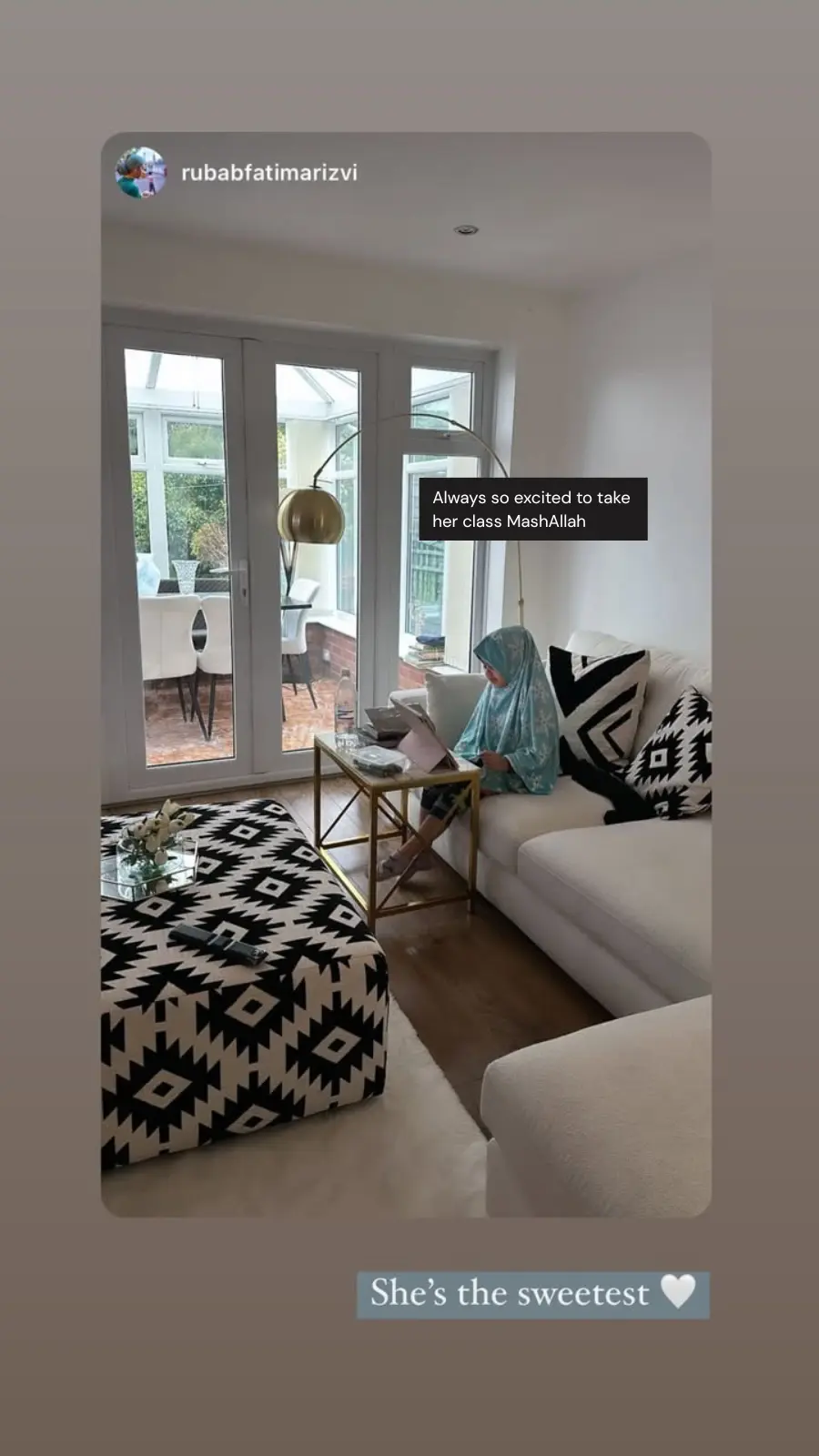
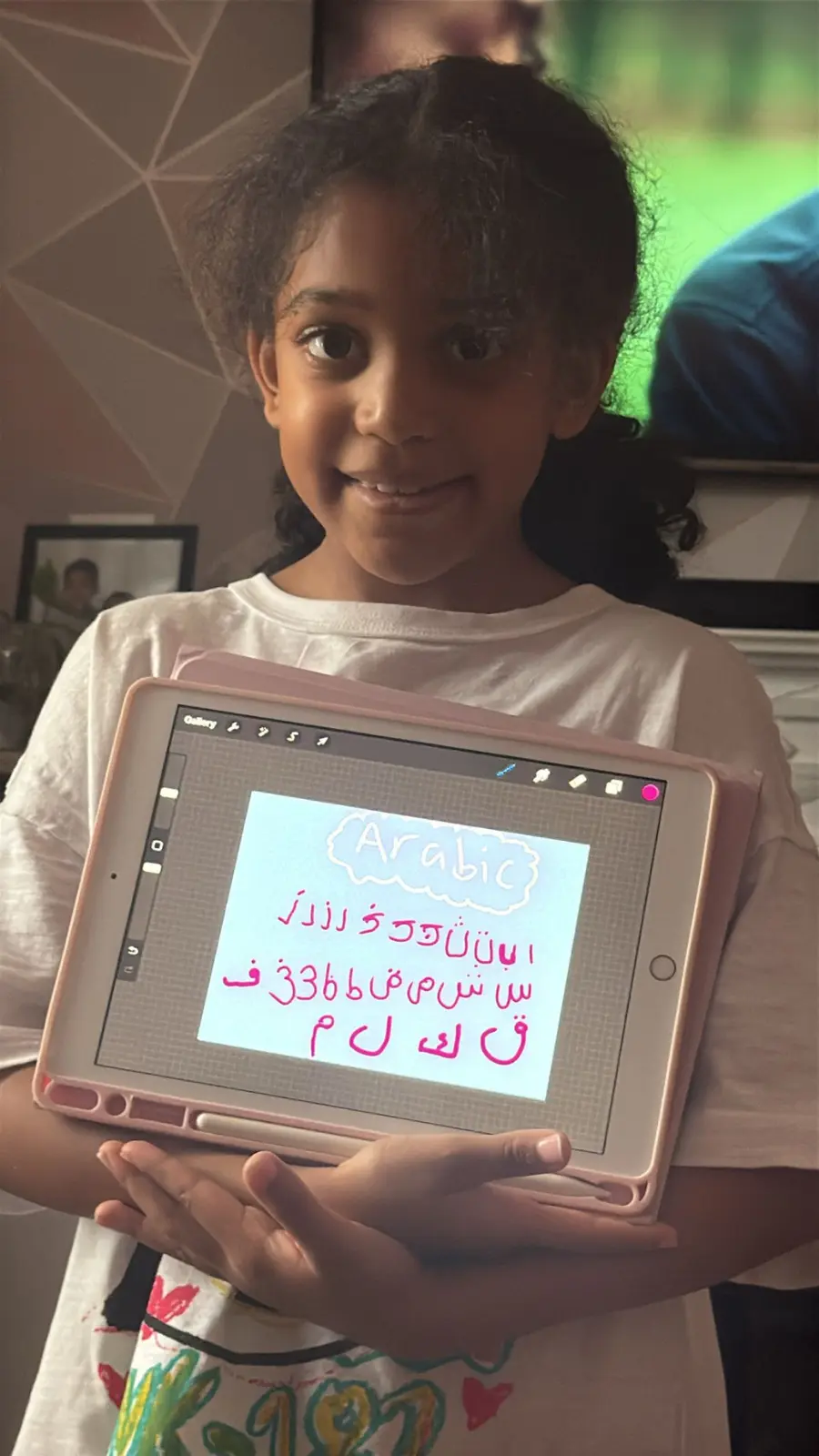
When they enrolled with Quran Skool, the shift was visible within two weeks. Six-year-old Ibrahim — with no prior Qur'an experience — responded to the visual, play-based approach immediately. His Mu'allim introduced Arabic letters through shapes and stories he already recognised, and within a month he was identifying all 28 letters independently, MashaAllah.

Zainab needed a different blessing: a teacher who met her where she was without making her feel "behind." Her female Tajweed Mu'allimah began at her actual level — not the level a printed syllabus said she should be at — and within six weeks, she was reciting Surah Al-Fatihah with Tajweed her previous programs had never produced.

That last line is the goal. Not a completed syllabus. Not a certificate. A child who wants to open the Qur'an on their own.

Begin Your Family's Journey

One Trial Session. One Honest Look. No Cost.

Watch your child meet a Mu'allim who has been waiting to teach them with kindness, in sha Allah.

Chapter Eleven

Common Mistakes Parents Make When Choosing Qur'an Classes

With so many platforms now available, the choice has become genuinely difficult. Here is honest counsel — from the nasihah tradition of our scholars.

Mistake One: Prioritising Price Over Pedagogy

The cheapest option is rarely the most effective for children. A low-cost group class your child attends for six months without progress costs far more — in time, in discouragement, in lost shauq (eagerness) — than a slightly costlier 1-on-1 program that actually works.

Mistake Two: Treating Tajweed as "Advanced Only"

Tajweed should begin from the very first lesson — woven into pronunciation modelling rather than introduced as a list of formal rules later. Parents who delay Tajweed often spend years correcting habits that formed in those earliest sessions.

Mistake Three: Skipping the Trial Class

Always observe at least one session before committing. Watch how the Mu'allim engages your child. Does your child lean in or check out? Is correction delivered with warmth or with frustration? A trial class is the only reliable evidence.

Mistake Four: Choosing Credentials Without Connection

An Ijazah-certified teacher who cannot engage a six-year-old will produce less learning than a warm, trained teacher who understands child development. Both qualifications matter — but with a child, style is non-negotiable.

Mistake Five: Starting With Long Sessions

Many parents believe more class time means more learning. With a young child, often the opposite is true. Begin short. Build up gradually. The Sunnah is consistency, not intensity.

A Foundational Hadith أَحَبُّ الْأَعْمَالِ إِلَى اللَّهِ أَدْوَمُهَا وَإِنْ قَلَّ

"The most beloved deeds to Allah are those that are most consistent, even if they are small."

— Sahih al-Bukhari 6464 · Narrated by Aishah (R)
Chapter Twelve

Tips For Supporting Your Child's Qur'an Learning at Home

No teacher in the world can produce lasting thabaat (steadfastness) without home reinforcement. Here are five practical, Sunnah-rooted strategies for the Muslim parent in America.

١

Tip One: Establish a Sacred Daily Rhythm

Consistency outweighs duration, MashaAllah. A focused ten-minute review every evening — perhaps after Maghrib, perhaps before dinner — creates a neurological routine that reinforces class learning and signals to your child that Qur'an time is family time.

٢

Tip Two: Let the Qur'an Live in Your Home

Background recitation is profoundly effective. Apps like Quran Majeed, or simple playlists of child-friendly recitation by reciters such as Sheikh Mishary Rashid Al-Afasy or Sheikh Maher Al-Mueaqly, normalise the sound of Arabic in your household. Your child begins to feel that the Qur'an belongs to their world — because it does.

٣

Tip Three: Celebrate Progress, Not Perfection

When your child reads a new letter, when they finish a Qaida page, when they correct themselves without prompting — mark the moment. Sticker charts, small rewards, the words "MashaAllah, I am so proud of you". The Prophet ﷺ used to praise the children around him generously.

٤

Tip Four: Frame the Qur'an as Gift, Not Obligation

The language of the parent matters enormously. "You have to do your Qur'an" creates a very different inner association than "It's Qur'an time — let's see what Allah teaches you today." One is a chore. The other is an invitation. Children absorb our framing more than our words.

٥

Tip Five: Connect the Class to Daily Salah

The first time your child memorises a short surah — Al-Ikhlas, Al-Kawthar, An-Nasr — say to them: "You know that surah from your Qur'an class? We recite it in every prayer, MashaAllah." The connection between class and worship transforms motivation in a way nothing else does.

رَبَّنَا هَبْ لَنَا مِنْ أَزْوَاجِنَا وَذُرِّيَّاتِنَا قُرَّةَ أَعْيُنٍ وَاجْعَلْنَا لِلْمُتَّقِينَ إِمَامًا

"Our Lord, grant us from among our spouses and offspring the coolness of our eyes, and make us a leader for the righteous."

— Surah Al-Furqan 25:74
Chapter Thirteen

Frequently Asked Questions

Honest answers to what every Muslim parent in America is wondering.

What is the best age to start Qur'an classes for kids?

Children may begin structured Arabic phonics and Qur'an preparation as early as 2.5 years of age, MashaAllah. At this stage, the focus is on sound-awareness, letter shapes, and gentle comfort with Arabic through play. Formal Qur'an reading with Tajweed typically begins at 5–6. However, in sha Allah, there is no "too late" — we work effectively with teenagers, and adults who are starting from zero. As the saying of our pious predecessors goes: "He who has not yet begun, let him begin today."

How do online Qur'an classes with Tajweed actually work for young children?

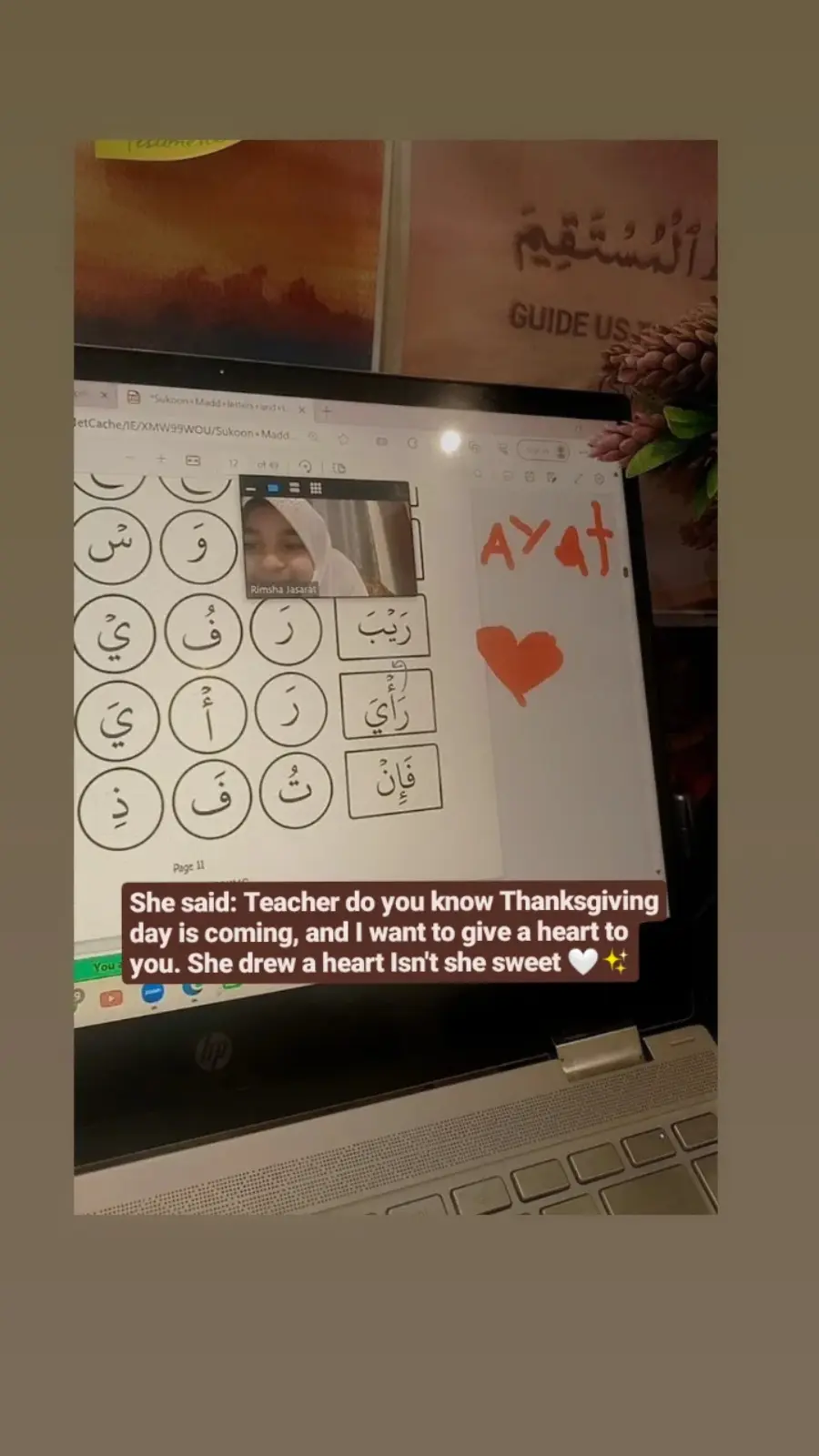
Sessions take place on Zoom or Google Meet with a child-trained Mu'allim who combines visual aids, call-and-response, and activity-based learning to maintain focus. Sessions run 15–30 minutes depending on age. The young remain engaged because the sessions are designed for their attention span — never stretched to fill an arbitrary slot.

How long does it take for a child to read the Qur'an with Tajweed?

For a child beginning from zero with consistent twice-weekly classes, fluent Qur'an reading with Tajweed application typically develops between 18 and 36 months, in sha Allah. This depends on the child's age, frequency of classes, and home reinforcement. Quran Skool paces the syllabus to the individual — your child progresses when they are ready, not when a curriculum chart demands.

Is there a free trial for online Qur'an classes for kids in the USA?

Yes, Alhamdulillah. Quran Skool offers a fully free trial — not a sales demo, not a placement test, but a real session with a qualified Mu'allim. You may observe, ask questions, and watch how your child responds. No payment required. No commitment expected.

Are female Qur'an teachers available for girls and young children?

Absolutely, MashaAllah. We have a complete team of qualified female Mu'allimaat — every one Tajweed-certified and trained in child pedagogy. Many families, particularly for daughters and the very young, prefer the warmer dynamic of a female teacher. You may specify your preference at the time of booking.

What if my child has tried Qur'an classes before and quit?

This is one of the most common situations we encounter, MashaAllah. Children who previously disengaged almost always did so because the teaching style, not the subject, was the obstacle. We begin by rebuilding trust and making class feel safe before introducing any academic pressure. Most children show a noticeable shift within the first three to four sessions, in sha Allah.

Do you offer Qur'an classes in Urdu for Pakistani families in the USA?

Yes, MashaAllah. Many of our Mu'allimeen are fluent Urdu speakers and conduct sessions in a bilingual English-Urdu format. This is especially valuable for South Asian households where the child thinks in English while the parent explains in Urdu — a gap our teachers are trained to bridge.

How are parents kept informed about progress?

Parents receive a monthly progress report covering lessons completed, pronunciation accuracy, Tajweed rules introduced, and areas for focused improvement. Mu'allimeen are also available for brief parent check-ins between sessions. You will never be left in the dark about your child's journey, in sha Allah.

Chapter Fourteen

Take the First Step — Book Your Free Trial

Fill out the form below and we will get back to you, InshaAllah, with the same care and attention we give to every family who entrusts us with their child's Qur'anic upbringing.

Tell Us About Your Child

Every child is unique. Share a little about yours and we'll match them with the perfect tutor, in sha Allah.

Why Choose Quran Skool

Trusted by Muslim families across the USA, UK and Canada, MashaAllah.

Take The First Step

Your Child Deserves a Relationship With the Qur'an — Not Just a Completed Syllabus

Pick a time in your U.S. timezone. Meet a teacher matched to your child's age and language. Watch one full live session with no cost and no pressure. Then, only if it feels right, In Sha Allah, we begin together.

✓ Zoom & Google Meet ✓ All U.S. Time Zones ✓ Male & Female Tutors ✓ Begin Any Day
وَنُنَزِّلُ مِنَ ٱلْقُرْءَانِ مَا هُوَ شِفَآءٌ وَرَحْمَةٌ لِّلْمُؤْمِنِينَ

"And We send down of the Qur'an that which is healing and mercy for the believers." — Surah Al-Isra 17:82

Scroll to Top